Key takeaways
- Washington sends every single-family pool and spa to the 2021 International Swimming Pool and Spa Code, through section R327 of the residential code. Each city adds its own permit and zoning rules.
- Seattle exempts only a prefabricated pool with its walls entirely above grade and 5,000 gallons or less. Bellevue requires a permit with plan review above 24 inches deep and Kirkland at two feet deep.
- The barrier is at least 48 inches high, with no opening a 4 inch sphere can pass, and gates that open outward, self-close and self-latch. A lockable spa cover or powered pool cover can replace it.
- Medina is the outlier: a swimming pool needs an administrative special use permit, and the house’s certificate of occupancy waits for the pool work.
- Put the pool on the house permit set from the first submission.
Short answer: on a high-end Seattle or Eastside lot, a pool is part of the permit set for the remodel. An in-ground pool needs a building permit in all five cities below, plus plumbing, electrical and mechanical work for the equipment, and it sits behind a barrier built to the 2021 International Swimming Pool and Spa Code. Where it can go depends on the city, and Medina adds a separate land use permit first. The pools that cause delay are the ones added after the house is in review, so I draw the pool, spa and patio on the first submission.
Rules below are from state law, city codes and city permit pages, read 7 October 2026. Confirm with your city before relying on a number.
What a pool adds to your permit set
Each city exempts only small pools above ground, and the thresholds differ. Anything dug into the ground needs a permit.
| City | When the pool needs a building permit | What else the city names |
|---|---|---|
| Seattle | A prefabricated pool is exempt only if its walls are entirely above the adjacent grade and it holds 5,000 gallons or less (Seattle Residential Code R105.2). | Separate plumbing, electrical or mechanical permits may still be required (R105.3). SDCI requires a grading permit for 750 square feet or more of new or replaced hard surface, or a grade change over 4 feet with more than 50 cubic yards. |
| Bellevue | A permit with plan review for a pool over 24 inches deep. The plan is designed and stamped by a Washington licensed professional or structural engineer. | Side sewer permit if it connects to the sewer. A clearing and grading permit may apply to a below-ground pool. |
| Kirkland | In-ground or above-ground pools two feet deep or deeper, spas built on site, and prefabricated above-ground pools over 5,000 gallons. | A prefabricated hot tub needs an electrical permit but no building permit. Soil removal or fill over 50 cubic yards, or a change in drainage, needs a permit. |
| Mercer Island | Exempt only: prefabricated pools under 24 inches deep, 5,000 gallons or less, entirely above ground (MICC 17.14, section 105.2). | These exemptions do not apply in flood hazard areas or critical areas. |
| Medina | Exempt only: prefabricated pools above grade holding no more than 24 inches of water (MMC 16.40.050). | A swimming pool also needs an administrative special use permit (MMC 16.34.040). |
Sources: Seattle Residential Code 2021; SDCI grading permit page; Bellevue pool and spa plan and work requiring permits pages; Kirkland Do you need a permit page; MICC 17.14; MMC 16.40.050 and 16.34.040. As of 7 October 2026, confirm with your city.
Which pool code applies in 2026
Washington’s residential code requires a single-family pool or spa to comply with the 2021 International Swimming Pool and Spa Code, or ISPSC (WAC 51-51-0327, section R327.1). The building code says the same (WAC 51-50-3109), Seattle repeats it in its residential code, and Mercer Island adopts it in MICC 17.18.010. R327 is the pool section in Washington; R326 is habitable attics. The 2021 codes took effect statewide on March 15, 2024 (WAC 51-51-008).
The State Building Code Council lists the 2024 codes as effective May 3, 2027, with final adoption targeted for October 16, 2026. A complete building permit application is judged under the code in effect the day it is filed (RCW 19.27.095). I have not confirmed whether the 2024 package changes the pool code edition, so if you will file near May 2027, ask the city.
The barrier, gates and the house wall
These ISPSC section 305 rules shape a design:
- Height. At least 48 inches above grade on the outside, all around and for 3 feet out from the barrier. A planter or low wall that raises the ground just outside the fence cuts the credited height. The gap under it is at most 2 inches over grass or gravel and 4 over a solid surface.
- Openings. A 4 inch sphere cannot pass. Where horizontal rails are under 45 inches apart, vertical bars are no more than 1 3/4 inches apart and the rails go on the pool side. Solid barriers cannot offer handholds or footholds.
- Gates. Pedestrian gates open outward, self-close and self-latch. A release reached from outside is at least 54 inches above the ground unless it is a key, electronic or combination lock.
- Equipment and construction. Pumps, filters and heaters outside the barrier sit at least 36 inches from it. A fence at least 4 feet high surrounds an in-ground pool site from the first excavation until the permanent barrier is done.
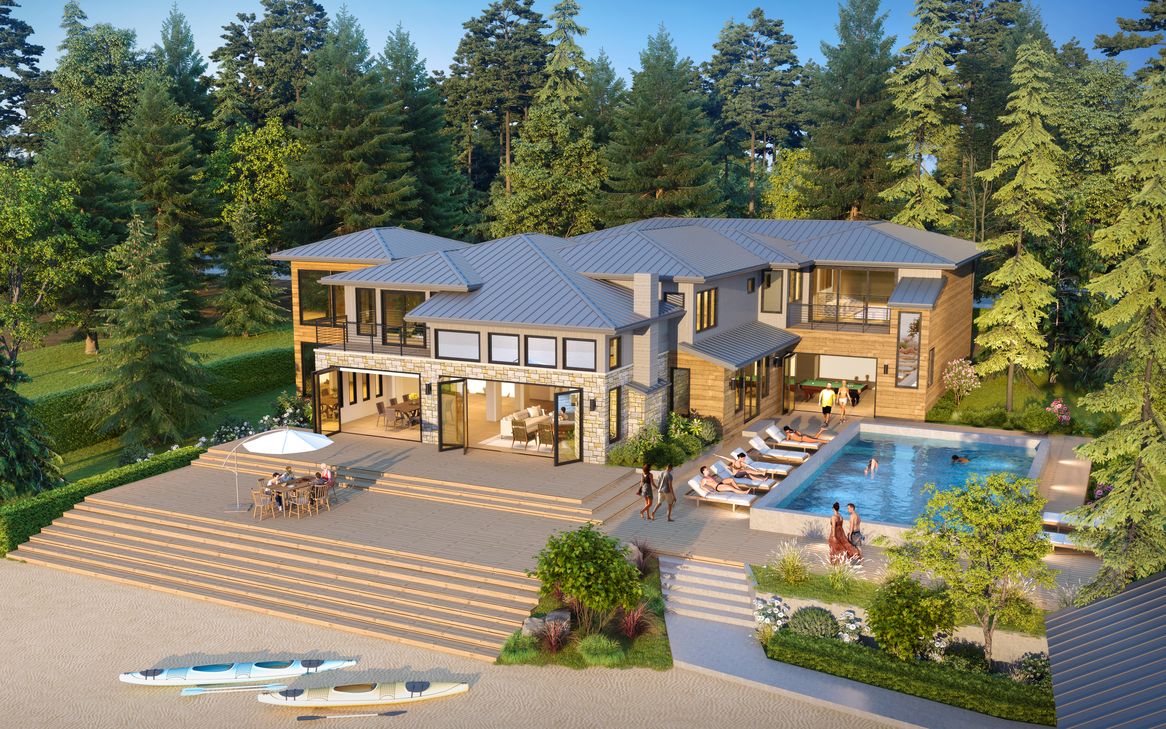
On a remodel the detail that matters is the house wall. When the back of the house is one side of the barrier and doors or windows open directly onto the pool, section 305.4 requires one of three things: a listed water hazard entrance alarm (UL 2017) on each door and each operable window with a sill under 48 inches, a listed safety cover, or approved protection such as self-closing, self-latching doors. If the great room opens onto the terrace, I settle which one applies before the doors are ordered. Bellevue’s pool plan page shows a four foot minimum fence with a self-closing, self-latching gate (Bellevue City Code 23.16.010).
Hot tubs, spas and covers
The pool code lets a cover stand in for a barrier. A spa or hot tub with a lockable safety cover that meets ASTM F1346, or a pool with a powered safety cover that meets it, does not need the fence, gate and alarm rules (ISPSC 305.1). Bellevue’s page says a locking cover may substitute for fencing on a spa. For a pool I draw the fence unless the city confirms the cover route in writing.
Permits vary. A prefabricated spa with walls entirely above grade and 5,000 gallons or less needs no building permit in Seattle, and Kirkland says the same of prefabricated hot tubs, but an electrical permit can still apply. A spa built on site needs a permit in Kirkland, and most spas in Bellevue need an electrical or mechanical permit. Medina lets a permanent hot tub skip the special use permit only if it sits within 20 feet of the house, stays out of every setback, has no special lighting beyond low in-water lighting, keeps equipment indoors or in a sound enclosure, has a barrier the building code prescribes and drains to the sanitary sewer (MMC 16.34.040).
The pool code also governs heating. Heaters need an on-off switch within 3 feet, heaters and pumps need time switches, and an outdoor heated pool or permanent spa needs a vapor-retardant cover unless over 70 percent of the heat comes from a heat pump or solar (ISPSC 303.1).
Where a pool can sit, city by city
Setbacks and coverage are where the cities differ most. I could confirm these four from the code or the city’s own pages.
| City | Where the pool can go | How it counts |
|---|---|---|
| Seattle | Unenclosed structures not more than 18 inches above existing or finished grade, including swimming pools and hot tubs, are allowed in any required setback (SMC 23.44.090.H). Neighborhood Residential setbacks for one or two dwellings on most lots: front 15 feet, rear 15 feet unless on an alley, sides 5 feet average and 3 feet minimum. | In Neighborhood Residential zones, maximum lot coverage is 50 percent (SMC 23.44.080). Underground structures and the unenclosed structures that meet 23.44.090.H are not counted. |
| Bellevue | The city’s setbacks page lists swimming pools among the items that can intrude into a setback. Its accessory structure page lists hot tubs: 10 feet from a street right of way, 5 feet from the rear line, and the house’s front and side setbacks, on lots under 20,000 square feet. | An accessory structure may cover up to 10 percent of the lot and counts toward lot coverage and impervious surface. Lot coverage, impervious surface and hard surface are separate limits (Land Use Code 20.20.010, note 37). |
| Mercer Island | No pool in a front yard, and the edge of the water at least 5 feet from any adjacent property (MICC 19.02.070). Hardscape up to 30 inches above grade may sit in a required yard (19.02.020). | Impervious surface is defined to include pools and hot tubs (MICC 19.16). Hardscape such as walkways and decks is capped at 9 percent of net lot area on lots over 8,400 square feet (19.02.020.F). |
| Medina | A pool may enter a setback if it stays 15 feet from each front and rear line and 10 feet from each side line, measured to the outer edge of the structural rim, with screening conditions (MMC 16.34.040). | Structural coverage counts swimming pools and spas (MMC 16.23.030). On a 25,000 square foot R-20 lot, 21 percent is 5,250 square feet of coverage and 52.5 percent is 13,125 square feet of impervious surface (Table 16.23.020(B)). |
Sources: SMC 23.44.080 and 23.44.090 (Municode, September 25, 2026 version); Bellevue setbacks and accessory structures pages, Land Use Code as amended by Ordinance 6851; MICC 19.02 and 19.16 (April 15, 2026 version); MMC 16.34 and 16.23 (May 6, 2026 version). Arithmetic is mine. As of 7 October 2026, confirm with your city.
Bellevue’s Land Use Code 20.20.125 sends swimming pools that are exempt from building permits through a separate process to enter side or rear setbacks, so I ask the city in writing how it treats an in-ground pool on the lot. Coverage numbers by zone are in my Bellevue zoning guide.
I left Kirkland out of that table because I could not read its zoning code today. Its shoreline code says swimming pools, fences, sheds and other accessory structures are not permitted within the shoreline setback except those the code lists, and decks and patios may extend up to 10 feet into it but generally no closer than 25 feet to the water (KZC 83.190, as adopted in Ordinance 4701 of 2020). For the pool yard rule, ask Kirkland Planning at 425-587-3600, and see my Kirkland zoning guide. Seattle’s rule favors a pool at grade: above 18 inches the allowance stops. My guides to decks and fences and walls cover the rest.
Slopes, trees, water and flood
A pool is a hole, and the city counts the hole. A 20 by 40 foot pool dug 6 feet deep moves 4,800 cubic feet, about 178 cubic yards (4,800 divided by 27), before the deck and equipment pad. That is well past Kirkland’s 50 cubic yard line, and in Seattle it passes the 4 foot and 50 cubic yard figures. Seattle’s line drops to 25 cubic yards in some critical areas.
- Steep slopes. Kirkland asks for a geotechnical report on or within 25 feet of a regulated slope. Bellevue’s permit page lists a geotechnical report and a critical areas land use permit as possible add-ons. See Seattle critical areas and sloped lot design.
- Trees. Kirkland’s checklist asks for a tree retention plan, and Seattle’s tree rules are in trees and remodeling in Seattle.
- The shoreline. Mercer Island holds structures 25 feet from the ordinary high water mark and limits hardscape and lot coverage to 10 percent from 0 to 25 feet and 30 percent from 25 to 50 feet (MICC 19.13.050). Kirkland treats pools and spas as normal appurtenances to a single-family house for the shoreline permit exemption (KZC 83.80). See my shoreline exemption guide and waterfront remodel guide.
- Flood. A pool in a designated floodway needs documentation that it will not raise the flood elevation, and equipment in any flood hazard area must be elevated or anchored (ISPSC 304). The code skips the barrier on a lake side only where the public cannot walk the shoreline (ISPSC 305.6). I would not count on that on a Washington lake.
Sequencing the pool with the house permit
- Survey first. Slope, trees, easements and, on the water, the ordinary high water mark. The pool location comes after.
- Draw the pool on the first permit set. Bellevue’s addition permit lists the pool and spa plan among documents that may be required with the building application and includes electrical, mechanical and plumbing, and the plan carries an engineer’s stamp. So the pool engineer is hired during design.
- In Medina, start with the special use permit. It is a Type 2 decision with a 14 to 30 day comment period and a 100 day processing time from a complete application, not counting time you take to answer questions (MMC 16.80.110 and 16.80.210). Permits processed separately cannot issue until the higher decision is final, unless the director waives it (MMC 16.80.090). The approval lapses after one year unless a complete building permit application is filed (MMC 16.71.030).
- Count hard surface once. The pool deck, patio, equipment pad and driveway add together against Seattle’s 750 square foot line and Kirkland’s 500 square foot stormwater drainage plan line (new or replaced impervious surface).
- Plan the finish. In Medina, when a pool permit is issued with the house’s building permit, the house’s certificate of occupancy waits until the related permits are completed, inspected and paid, unless the building official accepts a cash guarantee (MMC 16.40.080). Ask your city whether it ties them together.
My planning figures hold when the pool is on the set from the start: design to permit submission typically takes 2 to 4 months, and a Seattle remodel permit about 2 to 3 months. Medina’s 100 day clock is a separate item to schedule.
What I check first
Before I draw a pool I look at the zone and setback, the slope, the trees, the shoreline if there is one, and where the equipment and barrier can go. The first feasibility check is free and usually takes about a day. An in-depth analysis, with the setback and coverage math, the excavation count and the permit path for your city, is $1,500 and takes 2 to 3 weeks.
I quote a fixed fee for design and permit, set by the project budget and location, and the remodels I take on start at a project budget of $750,000. Piper Cole designs and administers construction for the owner and does not build. The pool builder and pool engineer are on the owner’s team, and I coordinate their drawings with the house. For the budget side, see my million dollar remodel guide.
Before you design
Find out where a pool or outdoor room fits on your lot
Send me the address and what you want to add. The first feasibility check is free and usually takes about a day.
Questions
Do I need a permit for a swimming pool in Seattle?
Yes for any pool dug into the ground. The Seattle Residential Code exempts only a prefabricated pool whose walls are entirely above the adjacent grade and that holds 5,000 gallons or less. Plumbing, electrical and mechanical permits may also be required, and SDCI requires a grading permit when a project adds or replaces 750 square feet or more of hard surface.
What does a pool permit in Bellevue require?
Bellevue requires a permit with plan review for a pool over 24 inches deep. The pool plan must be designed and stamped by a Washington licensed professional or structural engineer and show the fence, drains and connection points. A side sewer permit applies if the pool connects to the sewer, and a clearing and grading permit may apply to a below-ground pool.
What are the pool setback requirements in Bellevue?
Bellevue’s setbacks page lists swimming pools among the items that can intrude into a setback, and its accessory structure page lists hot tubs, which must be at least 10 feet from a street right of way and 5 feet from the rear line on lots under 20,000 square feet. The pool’s exact treatment on your lot depends on zone and critical areas, so ask Development Services to confirm in writing.
How high must a pool fence be in Washington?
At least 48 inches above grade on the outside, with no opening that passes a 4 inch sphere and no more than a 2 inch gap over grass or 4 inches over a solid surface (ISPSC 305.2). Pedestrian gates open outward and are self-closing and self-latching. Bellevue’s pool plan page shows a four foot minimum with the same gate rule.
Can a hot tub cover replace a fence?
Under the 2021 pool code, yes for a spa or hot tub with a lockable safety cover that meets ASTM F1346, and for a pool with a powered safety cover that meets the same standard (ISPSC 305.1). Bellevue’s page says a locking cover may substitute for fencing on a spa. Confirm the cover route with your city before you drop the fence.
Which code governs a pool in Washington in 2026?
The 2021 International Swimming Pool and Spa Code, adopted through section R327 of the residential code (WAC 51-51-0327) and section 3109 of the building code (WAC 51-50-3109). The 2021 codes took effect March 15, 2024. The State Building Code Council lists the 2024 codes as effective May 3, 2027, so ask which applies if you file near that date.
Why is a pool different in Medina?
Medina treats a swimming pool as a major accessory recreational facility that needs an administrative special use permit, a Type 2 decision with public notice and a 100 day processing time from a complete application (MMC 16.34.040, 16.71.030, 16.80.210). A pool may enter a setback only if it stays 15 feet from front and rear lines and 10 feet from side lines, with screening conditions.
Does a pool count toward lot coverage?
It depends on the city. Medina counts swimming pools and spas in structural coverage. Seattle does not count underground structures or unenclosed structures that meet its 18 inch rule. Mercer Island defines impervious surface to include pools and hot tubs and generally caps hardscape at 9 percent of net lot area. Bellevue sets lot coverage, impervious surface and hard surface as separate limits.
Can I add a pool after the house permit is issued?
You can, but it becomes its own application with its own review, and it adds to the hard surface and excavation counts on a site that was already reviewed. In Medina the special use permit and the certificate of occupancy hold also tie the two together. I put the pool on the first submission so one site plan, one engineer and one barrier design cover everything.
Authoritative sources
Regulatory requirements referenced in this guide are set by the official agencies below. Rules change, always confirm current requirements with the source: