The short answer, and the money
Short answer: on most lots here the answer is no, and the reason is almost never the acreage. It is lot width, street frontage or legal access. Where the answer is yes, the city and utility charges to create one new lot and connect a house to it run into tens of thousands before you pay a surveyor: in Kirkland, $56,415.83 from the published 2026 schedules.
Key takeaways
- The binding constraint is geometry, not area. A lot can hold twice the minimum lot size and still fail on minimum lot width or street frontage.
- There is a new, cheaper route in some cities: Washington’s 2025 lot splitting act, RCW 58.17.145, requires an administrative two lot split with no predecision hearing. Redmond has it in force; Bellevue deferred it to 27 July 2027.
- Splitting buys no extra units. A lot made by a lot split is carved out of the state middle housing density rule by RCW 36.70A.635(8)(e).
- The application fee is the small number. Kirkland’s short plat is $21,272.00, but the water, sewer and surface water capital facility charges on the new lot come to $20,446.00 on their own.
- Piper Cole designs and administers the construction contract. It does not build.
How to read the numbers here. Every city fee is quoted from that city’s own adopted 2026 schedule, linked beside it, read on 27 November 2026. Where a city publishes no figure I say so rather than supply one, and consultant and construction figures are labelled [EST] with the basis in the same sentence. Three of these cities publish their codified code only on hosts that refuse automated requests, so for those I quote the adopting ordinances and fee schedules instead.
Five names for dividing land, and why the name sets the price
Owners use these words interchangeably. Cities do not, and which one applies sets the fee, the review path and whether you get something you can sell.
| Process | What it is | How many lots | Who decides |
|---|---|---|---|
| Boundary line adjustment | Moves a line between existing lots; exempt under RCW 58.17.040(6) because it creates nothing new. Seattle calls it a lot boundary adjustment and Kirkland a lot line alteration. | No new lot, none left undersized | Staff |
| Short subdivision (short plat) | The ordinary route to new, separately sellable building lots. | Four or fewer under RCW 58.17.020(16), raisable to nine by ordinance. All four cities here went to nine. | Staff, with notice and appeal rights |
| Full subdivision (plat) | Engineered plans, preliminary then final approval. | Ten or more here | Hearing examiner, after a public hearing |
| Unit lot subdivision | Splits an approved project into separately owned lots, judged against the parent lot (RCW 58.17.020(19)). No second buildable site. | One per dwelling unit | Staff, no predecision hearing |
| Administrative lot split | The 2025 route under RCW 58.17.145: one new lot, clear and objective standards, no further split of either lot ever. | Two, once | Planning director, no administrative appeal |
Two traps: a boundary line adjustment creates nothing, and a unit lot subdivision only lets you sell attached units separately. Under RCW 58.17.060(1) land in a short subdivision may not be divided again within five years without a final plat.
What state law now forces, and the 2027 deadline
Two statutes matter. The middle housing law, RCW 36.70A.635, requires a city of at least 75,000 to authorize at least four units per lot in residential zones, six near a major transit stop or where two units are affordable, and zero lot line short subdivision up to that unit density. Bellevue’s Ordinance 6851 of 24 June 2025 recites that the city is subject to it (ordinance text), and Redmond replaced its numbered residential zones with one Neighborhood Residential zone (RZC 21.08).
The second is newer. Chapter 301, Laws of 2025, now RCW 58.17.145, requires cities to adopt an administrative lot split process decided “by the planning director or other designee based on applicable clear and objective development standards, with neither a predecision public hearing, nor any design review other than administrative design review.” The conditions are tight: one new lot, both lots meeting the minimum lot size, water and sewer certificates of availability, a parent lot that did not itself come from a lot split, and a note on the survey barring any further split. If the result would be a lot big enough to divide again, the route is closed.
Write the deadline down. Subsection (14) gives cities whose next comprehensive plan update falls in 2027 until that update, and “All other cities required to comply with this section must implement the requirements within two years of July 27, 2025.” For the King County cities that is 27 July 2027, as Bellevue’s own page puts it: “HB 1096 Lot splitting, due July 27, 2027” (Bellevue 2026 omnibus).
And splitting does not multiply units: RCW 36.70A.635(8)(e) says the middle housing density requirements do not apply to “A lot that was created through the splitting of a single residential lot pursuant to RCW 58.17.145.”
Seattle, Bellevue, Kirkland and Redmond side by side
Four cities, not one market: the fee for the same two lot result varies by a factor of three.
| City | Short plat ceiling | Lot split route today | Headline 2026 fee |
|---|---|---|---|
| Seattle | Nine or fewer parcels, SMC 23.24 (Tip 213A) | Not yet, on what I could read. The City’s September 2025 summary says new lots under 5,000 square feet could not be created and that OPCD and SDCI “will produce legislation in 2026 allowing lot splitting” (OPCD summary). | $7,064.25 at intake for a short plat or unit lot subdivision; $3,252.50 for a lot boundary adjustment (intake fees) |
| Bellevue | Up to nine new lots, LUC 20.45B (City page) | Adopted, not in force: LUC 20.45B.270 came in by Ordinance 6933 on 28 July 2026 and its section 79 defers it to 27 July 2027 (ordinance). Until then, short plat. | $3,040 deposit preliminary, $1,520 final, review at $304 an hour (Ordinance 6879) |
| Kirkland | Nine or fewer lots, KMC Title 22 (O-4907) | The City charges for one: “Residential Lot Split $9,563.00”, with a published checklist (forms page), while its March 2026 work program still called the work in progress (work program). | $21,272.00 short plat plus $3,223.00 recording review, or $9,563.00 lot split, plus 3.5 percent (fee schedule) |
| Redmond | Nine or fewer lots, RZC 21.74 (RZC 21.74.030) | In force: “Administrative lot splits must follow the procedures established in RZC 21.76.050.F, for a Type I review, and criteria established by RCW 58.17.145.” Ordinance 3261, codified August 2026. | $20,009.62 short subdivision, $9,298.04 single family boundary line adjustment, plus 4 percent (fee schedule) |
All of that is City work. King County Permitting handles the unincorporated county only, where the 2026 guide prices a two lot urban short plat at $17,140 for plan review plus $5,713 for final plat approval and a basic boundary line adjustment at $7,165 (Fee Guide 09), approved by the County Council on 18 November 2025 by Ordinance 20021 with a $126 screening fee added (fee page). Three County functions reach inside the cities too: the Recorder, the Assessor who issues the new parcel numbers, and the sewer treatment capacity charge.
Free feasibility check
Planning a custom home or a remodel of $750,000 or more?
Send me the address and a few lines about what you want. The first feasibility check is free and usually takes about a day.
The three tests that kill most splits
Minimum lot area. The test everyone runs, and the one most often satisfied. Bellevue’s Chart 20.20.010, adopted by Ordinance 6851, sets it at 35,000 square feet in LL-1, 20,000 in LL-2, 13,500 in SR-1, 10,000 in SR-2, 8,500 in SR-3, 7,200 in SR-4 and 4,700 in LDR-1 (ordinance text). SR-3 and SR-4 were numbered R-4 and R-5.
Minimum lot width and street frontage. The killer. The same chart requires a minimum width in the lot of 100, 90, 80, 70, 65, 60 and 50 feet across those districts, a minimum depth of 150 feet in LL-1 and 80 feet in the rest, and 30 feet of street frontage in every one. Kirkland says “In no case shall a lot be less than fifteen feet in width where it abuts the right-of-way, vehicular-access easement or tract providing vehicular access to the subject lot” (KMC 22.28.050). Seattle tests configuration instead: a lot line must abut the street for at least 10 feet, no lot may be under 10 feet wide for more than 10 feet, and no lot may have more than six straight lot lines (SDCI Tip 213A).
Legal access. A lot you cannot drive to is not a lot. In Kirkland an easement serving one to four lots needs 16 feet of unobstructed pavement in a 21 foot wide easement, cut to 10 feet in 15 feet where Public Works agrees, and “For five (5) or more lots, a dedicated and improved public right-of-way is required” (KZC 105.10). That is where a driveway problem becomes a road building problem.
A worked example on an 85 by 200 foot lot
Take Bellevue SR-3, formerly R-4. Each resulting lot needs 8,500 square feet of area, 65 feet of width, 80 feet of depth and 30 feet of street frontage.
Lot A: 85 feet of frontage, 200 feet deep. Area is 85 times 200, which is 17,000 square feet, and 17,000 divided by 8,500 is exactly 2, so the area test looks fine. Side by side, each lot gets 85 divided by 2, which is 42.5 feet, and 42.5 times 200 is 8,500 square feet: area passes, width fails at 42.5 against 65. Front and back, each lot is 85 by 100 feet, again 8,500 square feet, so area, width and depth pass, but the back lot has no frontage. A 30 foot strip to the street, 100 feet long, is 3,000 square feet out of the front lot, leaving it at 8,500 minus 3,000, or 5,500 square feet against a minimum of 8,500. A lot that passed the area test fails in every configuration.
Lot B: 130 feet of frontage, 131 feet deep. Area is 130 times 131, which is 17,030 square feet, thirty more than Lot A. Side by side gives two lots of 65 by 131 feet: area is 65 times 131, or 8,515 square feet, past 8,500; width is 65, exactly at the minimum; depth is 131, past 80; frontage is 65 feet each, past 30. Every test passes, with no easement and no flag lot.
Two lots of near identical area, opposite answers. The real test in SR-3 is not 17,000 square feet of land. It is 130 feet of street frontage, because 2 times 65 is 130, and the same doubling gives 200 feet in LL-1, 180 in LL-2, 160 in SR-1, 140 in SR-2, 120 in SR-4 and 100 in LDR-1.
City application and review fees
Seattle charges a flat sum at intake and then bills hours. The 2026 Land Use Intake Fees table, revised January 2026, prices “Short Plat/Unit Lot Subdivision” at a $5,510.00 minimum fee covering 10 hours, plus $292.00 intake, $205.50 additional and $1,056.75 public notice, for $7,064.25 due at intake. A full subdivision is the same $7,064.25 at the door, a lot boundary adjustment is $3,252.50, and the implied rate is $551.00 an hour (Seattle 2026 intake fees).
Bellevue works on deposits. Ordinance 6879, effective 1 January 2026, sets land use review at $304 an hour with a $3,040 deposit for a preliminary short plat, $1,520 for the final, $10,944 for a preliminary plat and $4,560 for a final plat (Table 20), with survey review a separate $190 an hour. The deposit is not the price: hours beyond it are billed monthly. Neither Table 20 nor its 2027 successor prices a lot split, so Bellevue has adopted the code without pricing it.
Kirkland publishes fixed fees, the highest here. From the Land Use Permit Fee Schedule 2026, effective 1 January 2026: short plat $21,272.00, unit lot short plats $13,790.00, short subdivision recording review $3,223.00, lot line alteration $3,223.00, residential lot split $9,563.00, preliminary subdivision $35,233.00, hourly $179.00, plus 3.5 percent on every permit (fee schedule). Its presubmittal conference for an owner’s own single family project is listed at no fee.
Redmond charges one fee including a resubmittal: $20,009.62 for a short subdivision with a $7,768.99 resubmittal fee, $29,194.59 for a preliminary plat and $9,298.04 for a single family boundary line adjustment, plus a 4 percent technology surcharge, effective 1 February 2026 (Redmond fee schedule). No resolution number appears on its four pages and no line item prices an administrative lot split.
Then the Recorder. King County records a plat or short plat on an 18 by 24 inch sheet for $423.50 with $5 per additional page, under a table marked “Effective January 1, 2024” (King County Recorder).
The consultants a split needs
A split is a survey problem before it is a design problem. You need a Washington professional land surveyor for the boundary and topographic survey and for the recorded plat or lot split survey, and a title report: Bellevue asks for one dated 90 days or less before application. Usually a civil engineer, and on a sloped or treed site a geotechnical engineer and an arborist.
I published those figures with the basis for each two days ago, so I will not restate them: the pre-construction consultant costs page covers each consultant and the survey and geotechnical guide sets out what each report must contain. For the split itself, plan on $12,000 to $30,000 [EST] for the survey, civil engineering, drainage design and title work a two lot division needs. Basis: written proposals I have seen as the owner’s architect on Seattle and Eastside projects in 2025 and 2026, not quotes, because nobody publishes consultant fees.
The real cost: utilities, frontage, access, stormwater
Utility connections. The statute requires water and sewer certificates of availability before approval, so this gets tested early. Kirkland publishes the numbers. At the smallest meter size the water capital facility charge is $4,872.00 and the Cascade Water Alliance regional capital facility charge is $8,852.00, for $13,724.00, plus a $401.00 meter drop-in. Sewer is $5,124.00 plus $736.00 for the side sewer inspection, and the surface water capital facility charge for “One new detached dwelling on a single lot” is $1,598.00 (Public Works Fee Schedule January 2026). A new connection also pays a King County sewer treatment capacity charge, which Kirkland names but does not price, so neither do I.
Frontage improvements and dedication. State law allows both: a split “may be conditioned upon dedication of right-of-way on the parent lot” and building on the new lot “may be conditioned upon construction of frontage improvements.” In practice that is curb, gutter, drainage, a planter strip with street trees and a sidewalk across your frontage, routinely the largest single line in the project.
Access and stormwater. Either a shared driveway inside a recorded easement, built to the pavement widths above, or a public road once you cross the five lot line. Creating a lot also changes the stormwater category: an infill house not in a subdivision gets Kirkland’s simplified review at $1,926, while a subdivision gets full review at $4,857 plus $1,600 per lot public and $500 per lot private improvement review.
Together, the infrastructure on a split runs $25,000 to $150,000 and up [EST]. Basis: the published charges above plus contractor pricing I have seen on Seattle and Eastside projects in 2025 and 2026. A flat lot with both mains in the street and a sloped lot needing a detention vault are not the same job.
A worked total: one new lot in Kirkland
Two lots, short plat route, one new detached house on the new lot, smallest meter, all 2026 published figures.
| Line | Arithmetic | Amount |
|---|---|---|
| Short Subdivision Fixed Fee (Short Plat) | published fixed fee | $21,272.00 |
| Short Subdivision Recording Review | published fixed fee | $3,223.00 |
| MyBuildingPermit.com surcharge, 3.5 percent | 0.035 times 24,495.00 | $857.33 |
| Public improvement review at intake | $1,600 times 2 lots | $3,200.00 |
| Private improvement review at intake | $500 times 2 lots | $1,000.00 |
| Stormwater review, full, subdivision | published fixed fee | $4,857.00 |
| King County recording, 18 by 24 inch sheet | County Recorder table | $423.50 |
| Subtotal to create the lot | 25,352.33 plus 9,057.00 plus 423.50 | $34,832.83 |
| Water capital facility charge plus Cascade regional charge | 4,872.00 plus 8,852.00 | $13,724.00 |
| Water meter drop-in | published fixed fee | $401.00 |
| Sewer capital facility charge, single family | published fixed fee | $5,124.00 |
| New side sewer inspection | published fixed fee | $736.00 |
| Surface water capital facility charge | one new detached dwelling on a single lot | $1,598.00 |
| Subtotal to connect the new house | 14,125.00 plus 5,860.00 plus 1,598.00 | $21,583.00 |
| Total, city and utilities only | 34,832.83 plus 21,583.00 | $56,415.83 |
The surcharge, worked: 21,272.00 plus 3,223.00 is 24,495.00; times 0.035 is 857.325, so $857.33, giving a planning side of $25,352.33. Public works intake is 3,200.00 plus 1,000.00 plus 4,857.00, or $9,057.00. Kirkland’s schedule exempts capital facility charges, impact fees and meter installation from the technology fee, so I have not added it there.
The cheaper route: if the lot qualifies for Kirkland’s Residential Lot Split instead of a short plat, the planning fee is 9,563.00 plus 3.5 percent, which is 9,563.00 times 0.035, or $334.71, giving $9,897.71. Against $25,352.33 that is a saving of $15,454.62 for the same two lot outcome. The utility and stormwater charges do not change: they attach to the new connection, not to the paperwork.
Not included: consultants, construction, impact fees for parks, schools, fire and transportation, the King County capacity charge, and my fee. On a straightforward Eastside lot, budget the city and utility side between $35,000 and $80,000.
Trees and critical areas
Trees move lot lines, not the other way round: a significant or exceptional tree and its protected root zone can make the second lot unbuildable. Seattle tree rules for building and remodeling sets out how that works in the city, and each Eastside city runs its own tree code. Critical areas are blunter: RCW 58.17.145(6) says lots “that are not buildable according to locally adopted development regulations including, but not limited to, critical areas, shorelines, stormwater, setbacks, impervious surface areas, and building coverage standards, are not eligible.” Lot coverage, setbacks and floor area in Seattle covers what is left to build with, and the Bellevue zoning guide covers the chart used above.
What you decide first, and is it worth it
One: measure the frontage, not the acreage. Find your zone’s minimum lot width and double it. If your frontage is under that number, a side by side split is out and you are into flag lots and easements.
Two: decide what you actually want. A lot to sell, a house for a family member, or more rentable building. If it is the last, a split is the wrong tool: it adds no units, and the middle housing rules may already allow more on the lot you have.
Three: find out which route your city offers today. Redmond has the administrative lot split in force, Bellevue waits until 27 July 2027, Kirkland has a priced application and a checklist, and Seattle’s legislation is still coming. In Kirkland alone the gap between the two routes is $15,454.62.
Four: test access and utilities before you commission a plat. If the new lot needs 16 feet of pavement in a 21 foot easement across the front lot, draw that first and see what is left.
Is it worth it? Sometimes, clearly: a wide lot in a zone with a modest minimum width, mains in the street and a flat buildable second site is a strong project. Often it is not, because these costs are mostly fixed and do not shrink because your lot is ordinary. On a lot that barely clears the dimensional tests the honest answer is usually to keep one lot and build better on it. Nor does the law require an architect for a house: RCW 18.08.410(5) exempts design and contract administration for “a residential building of up to and including four dwelling units.”
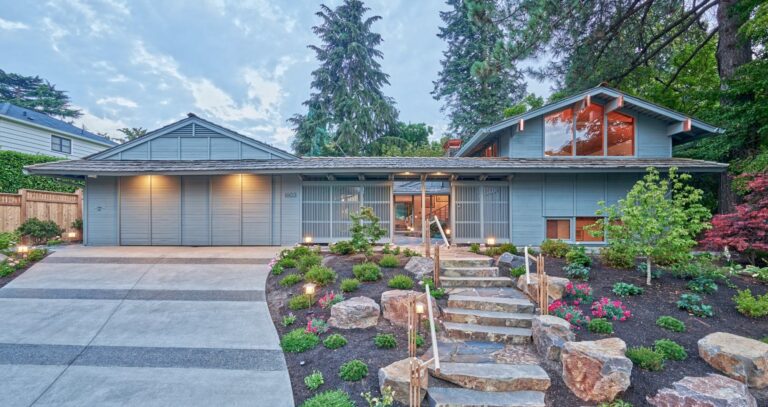
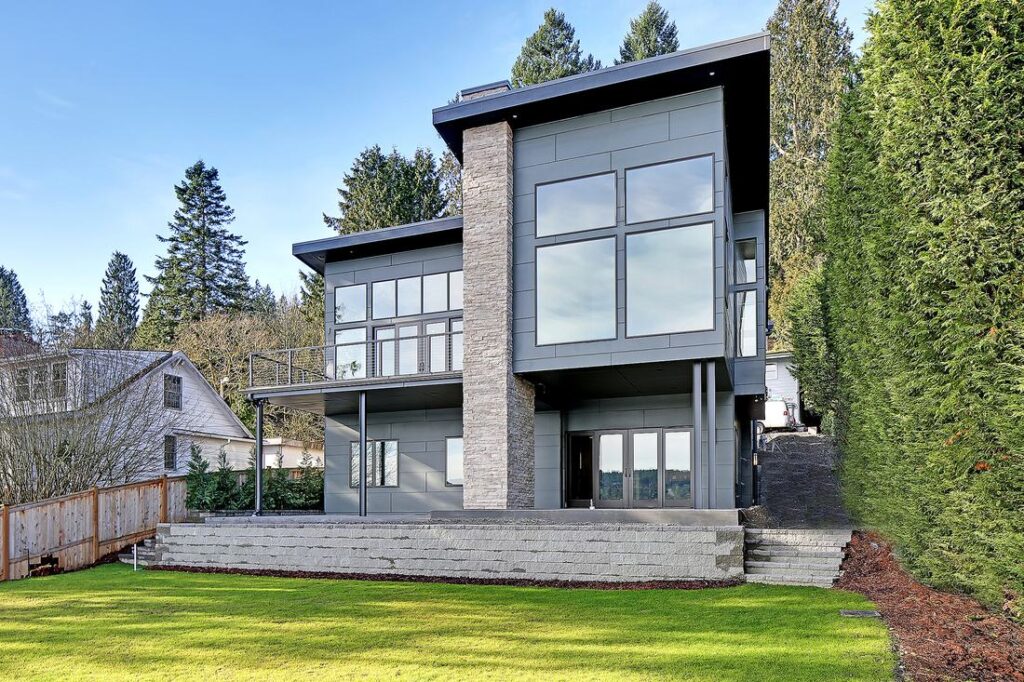
Selected work
Projects from the practice, for a sense of what the budget buys.
 Seattle Residence
 Strava Residence
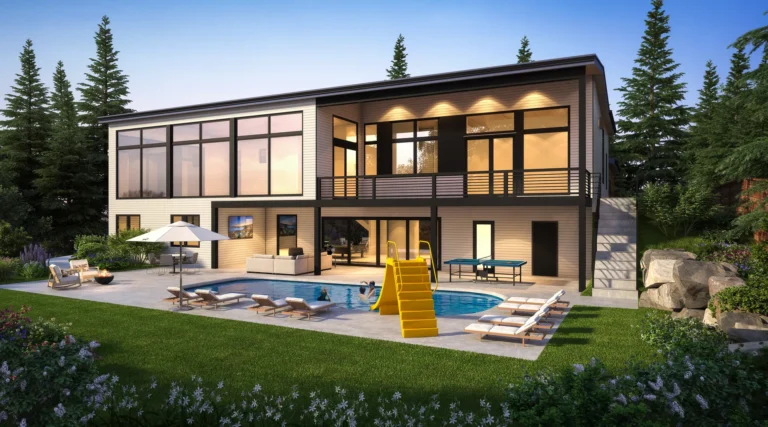 Holmes Point Residence
Start with the free feasibility check
Send me the address and I will tell you whether the lot can be split
The first basic feasibility check is free and usually takes about a day. Send the address, the rough lot dimensions and what you want to achieve, and I will tell you which process your city would apply, which of the area, width, frontage and access tests your lot passes or fails, and what the city and utility side would cost from the current schedules. If it is worth going further, the in depth analysis is $1,500 and takes 2 to 3 weeks. After that I quote a fixed fee for design and permit, set by project budget and location and agreed before design starts. Some firms quote a percentage of construction cost instead; I do not. I have practised as an architect since 1996, have been an AIA member since 1992 and an NCARB member since 1996, hold three Masonry Excellence Awards for commercial projects, and my work has been featured in Above The Lake and Lux magazines.
Questions
Can I split my lot in Seattle?
Seattle processes a short subdivision of nine or fewer parcels under Seattle Municipal Code chapter 23.24, so a two lot division goes that route today. SDCI Tip 213A, updated 22 May 2025, sets the lot configuration tests: one lot line must abut the street for at least 10 feet, no lot may be under 10 feet wide for more than 10 feet at any point, and no lot may have more than six straight lot lines. On the administrative lot split under the 2025 state act, the City’s own September 2025 summary of its permanent middle housing legislation says new lots smaller than 5,000 square feet could not be created and that OPCD and SDCI would produce lot splitting legislation in 2026. I could not read Seattle’s codified code to confirm whether that has landed, because the host refuses automated requests, so confirm the current position with SDCI before you budget.
How much does a short plat cost in Kirkland?
Kirkland’s adopted Land Use Permit Fee Schedule 2026, effective 1 January 2026, lists the Short Subdivision Fixed Fee at $21,272.00 and Short Subdivision Recording Review at $3,223.00, and every permit carries an additional 3.5 percent surcharge, which on those two is $857.33. That is $25,352.33 in planning fees. Public works intake for a subdivision adds $1,600 per lot for public improvement review, $500 per lot for private improvement review and $4,857 for full stormwater review, which on two lots is $9,057.00. King County recording of the mylar is $423.50. Consultants, impact fees and construction are all separate.
What is the difference between a lot line adjustment and a lot split?
A boundary line adjustment moves a line between lots that already exist. Under RCW 58.17.040(6) it is exempt from the subdivision chapter precisely because it creates no additional lot and may not leave a lot that is too small or too narrow to build on. You cannot end up with something new to sell. A lot split, under RCW 58.17.145, creates exactly one new buildable lot, administratively, and records a note on the survey saying neither resulting lot may ever be split again. The fee gap is large: in Kirkland a Lot Line Alteration is $3,223.00 against $9,563.00 for a Residential Lot Split, and in Seattle a Lot Boundary Adjustment is $3,252.50 at intake against $7,064.25 for a short plat.
Does Washington’s new lot splitting law mean my city has to let me split?
It means your city has to offer the process, not that your lot qualifies. RCW 58.17.145 requires cities to include an administrative lot split process in their development regulations, and sets the deadline as the 2027 comprehensive plan update or, for all other cities, within two years of 27 July 2025, which is 27 July 2027. Bellevue’s own project page lists it as “HB 1096 Lot splitting, due July 27, 2027”. But the conditions still bind: one new lot only, both lots must meet the minimum lot size, water and sewer certificates of availability must be issued, the parent lot must not itself have come from a lot split, and a lot that is unbuildable because of critical areas, shorelines, stormwater, setbacks, impervious surface or coverage standards is not eligible at all.
If I split my lot, can I build four units on each new lot?
No. RCW 36.70A.635(8)(e) says the state middle housing density requirements do not apply to a lot created through the splitting of a single residential lot under RCW 58.17.145. The same lot splitting statute also forbids a city from capping the two lots below what the parent lot allowed before the split. So the unit count follows the land, not the lot lines. Bellevue’s adopted lot split section goes further and puts a note on the face of the survey limiting the new lot to one unit less than the parent lot’s total allowance. If more units is the goal, check what the middle housing rules already allow on the undivided lot first.
What is a unit lot subdivision, and is it the same as splitting my lot?
It is not. A unit lot subdivision carves an approved residential development on a parent lot into separately owned lots, one per dwelling unit, so attached units can be sold individually rather than as condominiums. Under RCW 58.17.020(19) the project is judged against the standards for the parent lot, which means an individual unit lot can be nonconforming on its own. It does not give you a second empty buildable site. Every city in a county planning under the Growth Management Act has to offer it: Kirkland added KMC chapter 22.22 by Ordinance O-4907 on 17 June 2025 and prices Unit Lot Short Plats at $13,790.00, and Seattle charges the same $7,064.25 at intake for a unit lot subdivision as for a short plat.
My lot is big enough. Why did the city say no?
Almost always width, frontage or access rather than area. In Bellevue’s SR-3 district the minimum lot area is 8,500 square feet but the minimum width in the lot is 65 feet and the minimum street frontage is 30 feet, so an 85 foot wide lot with 17,000 square feet of area fails every configuration: side by side gives two 42.5 foot lots, and front to back leaves the rear lot with no street frontage. A 130 foot wide lot with almost the same area passes cleanly. Kirkland adds that no lot may be less than fifteen feet wide where it abuts the right of way or the access easement, and that an easement serving one to four lots needs 16 feet of pavement in a 21 foot easement. Measure the frontage before you measure the acreage.
How long does a lot split or short plat take?
Nobody should promise you a date, and I will not. What I can point at is the statutory frame: an administrative lot split application is subject to the maximum time period for local government action in RCW 36.70B.080 unless both sides agree in writing to extend it, and the lot split decision is made by the planning director with no predecision public hearing and no administrative appeal where the standards are met. A full subdivision is a different animal, with a public hearing, preliminary approval and then a final plat. The practical driver is not the clock on the city’s desk. It is how many rounds of resubmittal your survey, civil plans and drainage report need, which is why Redmond’s schedule carries a separate $7,768.99 resubmittal fee on a short subdivision.
What does the free feasibility check cover, and what should I send?
The first basic feasibility check is free and usually takes about a day. Send the address, the rough lot dimensions and frontage, and what you are trying to achieve, plus any survey or title report you already hold. I will tell you which process your city would apply today, which of the area, width, depth, frontage and access tests your lot passes or fails, where the access and the utility connections would have to go, and what the city and utility side would cost from the current published schedules. An in depth analysis, with the arithmetic worked against your own survey, is $1,500 and takes 2 to 3 weeks. If you go ahead, my design and permit fee is a fixed fee, set by project budget and location and agreed before design starts.